
When you buy a hybrid inverter, the battery voltage is fixed by its design. A 48V inverter needs a 48V battery bank. So this is a decision you make once, and it’s worth understanding.
- Small systems around 1 to 3kW often use 24V.
- Systems around 4kW and above usually use 48V.
- Higher voltage means lower current, thinner cables and less heat.
- The inverter decides the battery voltage, so they must match.
The basic idea: power = voltage x current
To deliver the same power, a higher-voltage system needs less current. For example, 3,000W from a 24V battery needs about 125A. From a 48V battery, about 62A.
Why does current matter? Higher current means thicker cables, more heat in connections, bigger fuses and more energy lost as heat. Halving the current makes everything easier.
When 24V makes sense
- Small systems around 1 to 3kW, like shops and small homes.
- Upgrading from an old UPS with two 12V batteries.
- Light loads: fans, lights, fridge, TV, router.
Many small inverters are designed for 24V because it keeps battery costs down at this size. See our small inverter guide.
When 48V is the better choice
- Systems around 4kW and above.
- Homes running ACs, motors and multiple heavy appliances.
- Anyone planning to add more batteries later.
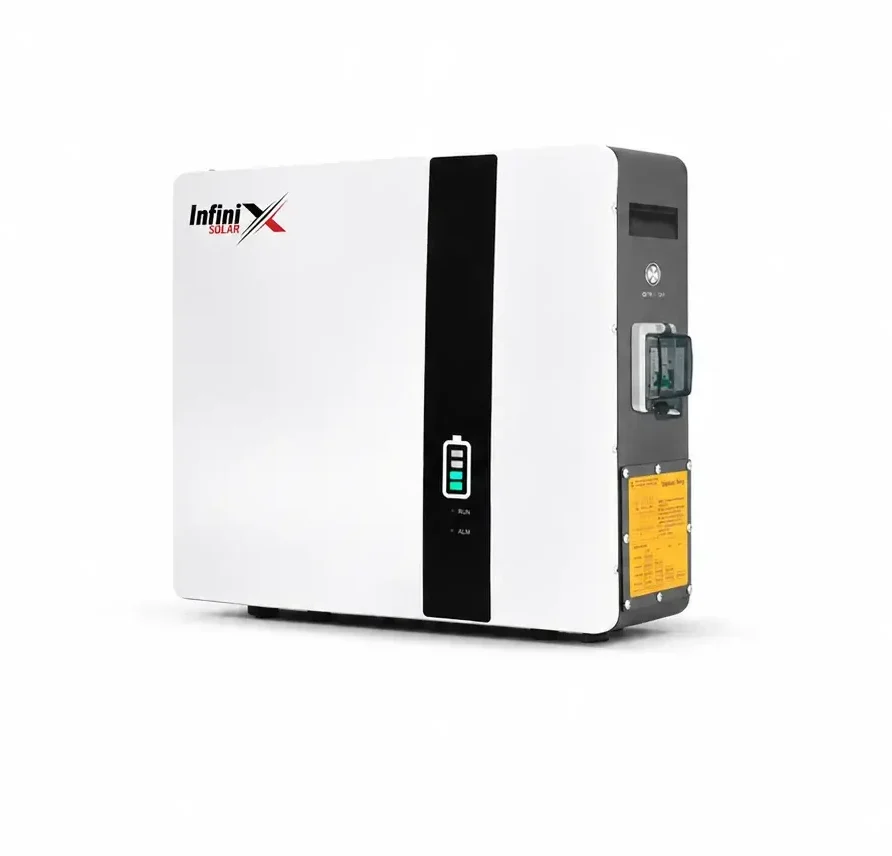
- Lithium batteries, which are commonly built as 48V (or 51.2V nominal) modules.
Most mid-size hybrid inverters, including the 4kW and 6kW units in the Infinix range, work with 48V batteries.
What about high-voltage batteries?
Some larger hybrid and commercial inverters use high-voltage battery stacks of a few hundred volts. These are efficient for big systems but need the specific inverter and battery to match. Not something to mix and match.
Things to keep in mind
- Choose the inverter first, then the battery to match its voltage.
- If you’re moving from tubular to lithium later, make sure a lithium battery is available in your inverter’s voltage.
- Don’t connect batteries of different ages or types in series to make up voltage.
- Battery cables must be sized for the current, not just the voltage.
If you’re unsure, use the load calculator to find your inverter size first. The voltage usually follows naturally from there.
Not sure which voltage your system needs?
Tell us your load and inverter. We’ll confirm the right battery voltage and size.