
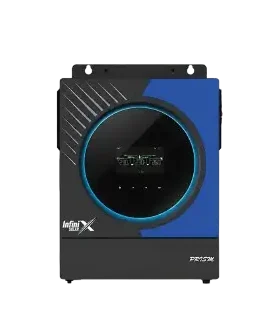
People are often surprised when their battery drains faster than expected, even with only a fan and a few lights on. Part of the answer is the inverter itself. Every inverter uses some power just to stay switched on, run its display, fans and electronics, and convert DC to AC. This is called idle or no-load consumption.
- Idle consumption is listed on the spec sheet as no-load or self-consumption.
- It usually ranges from a few tens of watts upward, depending on size.
- Over a 10-hour night it can use a noticeable share of a small battery.
- Bigger inverters typically have higher idle consumption.
Where to find it
Look on the inverter’s datasheet for “no-load consumption”, “idle consumption” or “self-consumption”. It’s measured in watts. Our guide on reading inverter spec sheets explains where it usually appears.
Why it matters at night
Say an inverter uses 50W just being on. Over a 10-hour night, that’s 0.5kWh, or 500Wh. On a 5kWh battery with 80 to 90 percent usable capacity, that’s more than a tenth of your night-time energy gone before any fan turns on.
Oversizing makes it worse
A much larger inverter than you need usually has higher idle consumption. If your night load is only fans and lights, a huge inverter running all night wastes more energy. This is one reason correct sizing matters. See choosing 4kW, 5kW or 6kW.
Conversion losses
Besides idle consumption, inverters lose some energy converting DC to AC. Efficiency is usually high at medium loads and lower at very light loads. So running a single 10W bulb through a big inverter all night is inefficient.
How to reduce the impact
- Size correctly: choose an inverter that matches your real loads.
- Check power-saving modes: some inverters offer eco or power-saving settings. Use them only if they don’t cause problems with sensitive loads.
- Turn off what you don’t need: TVs on standby, chargers and set-top boxes add up.
- Plan battery size with idle consumption included.
Factor it into battery sizing
When calculating how much battery you need for the night, add the inverter’s own consumption to your load. Our guide on battery for the night shows the steps.
Don’t panic over small numbers
Idle consumption is normal and unavoidable. The goal is to understand it so your expectations match reality. If your battery drains much faster than expected, the Infinix Solar support team can review your settings and loads through the monitoring data.
Battery draining faster than expected?
Share your inverter model, battery size and night-time loads with Infinix Solar. We’ll check whether settings or sizing are the issue.