
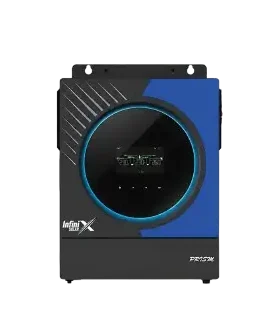
Your panels don’t have one fixed output. As the sun moves, clouds pass and the roof heats up, the voltage and current they produce keep shifting. Somewhere in that range there’s a sweet spot where you get the most watts. MPPT, or Maximum Power Point Tracking, is the part of the inverter that keeps hunting for that spot, many times a second.
- MPPT keeps your panels working at their best voltage as sun and heat change.
- It typically gets noticeably more energy than an old PWM controller.
- Check the MPPT voltage range and make sure your panel string sits inside it.
- Two MPPT inputs help when panels face different directions.
A simple way to picture it
Think of a car with gears. Drive in the wrong gear and the engine either strains or races, but you don’t go faster. MPPT keeps shifting the “gear” between your panels and your batteries or house, so the panels run at the speed where they make the most power.
MPPT vs PWM
Older and cheaper charge controllers use PWM. They basically connect panels straight to the battery and pull the panel voltage down to battery voltage. Whatever extra voltage the panel had is wasted. MPPT converts that extra voltage into extra current instead.
In real life, an MPPT system usually harvests clearly more energy than PWM, and the gap gets bigger in winter and on cold mornings when panel voltage is high. That’s why almost every hybrid inverter sold today, including all Infinix hybrids, uses MPPT.
The numbers to check on the spec sheet
- MPPT voltage range: for example 120 to 450V. Your panel string’s working voltage (Vmp) should sit comfortably inside this range, not near the edges.
- Max PV input voltage: the absolute limit. Your string’s open-circuit voltage (Voc) on a cold winter morning must stay below it, or you risk damaging the inverter.
- Max PV input current: modern 580W panels push higher current than old panels. Make sure the inverter accepts it.
- Number of MPPTs: one tracker is fine if all panels face the same way. Two are useful if some panels face east and some west, or if part of the roof gets shade.
Why this matters when you buy panels
We regularly see systems where a dealer put too many panels in one string. On a cold January morning, the voltage climbs past the inverter limit and the unit shows a PV overvoltage error, or worse, gets damaged. Ask your installer to show you the string calculation. It takes two minutes and saves a lot of trouble.
Bottom line
MPPT is not a luxury feature anymore, it’s the standard. What separates a good setup from a bad one is whether the panel strings are matched to the inverter’s MPPT range. If you share your panel model and how many you plan to use, we’ll check the string for you. Or start with the load calculator to get your system size first.
Want us to check your string voltage?
Send the panel model, quantity and inverter. We’ll confirm it’s within range.