

Most people pick an inverter size the same way: a neighbour has 6KW, so 6KW sounds about right. Sometimes that lands well. Often it means paying for capacity that never gets used, or discovering in July that the air conditioner trips the whole system.
Sizing is not complicated. It comes down to two separate questions that people tend to merge into one.
The two questions
1. How much power do you need at once? Measured in watts or kW. This decides the inverter size, because the inverter has to carry everything switched on at the same moment.
2. How many units do you use in a day? Measured in kWh. This decides the panel array and the battery, because they have to supply that total.
A house can have a high peak and low daily consumption, or the reverse. Sizing everything off one number is how systems end up wrong in both directions at once.
Step one: add up what runs at the same time
Work through the house and list what is genuinely on together on a bad evening. Indicative running figures for common Pakistani households:
| Appliance | Running power | Notes |
|---|---|---|
| Ceiling fan (regular) | 75–80 W | A DC inverter fan is about 35 W |
| LED bulb / tube light | 9–20 W | |
| LED TV | 60–100 W | |
| Refrigerator (inverter) | 150–250 W | Cycles on and off; roughly 1.5–2 units a day |
| Washing machine | 400–600 W | Short runs |
| Water pump (0.5 HP) | about 400 W | High surge on start-up |
| Iron | 1,000–1,200 W | |
| Microwave | 1,000–1,200 W | |
| 1 ton inverter AC | 900–1,100 W | Settles lower once the room is cool |
| 1.5 ton inverter AC | 1,200–1,500 W | The single biggest load in most homes |
Add up a realistic simultaneous set. A typical mid-size home running two 1.5 ton inverter ACs, a fridge, six fans and the lights is around 3,800 to 4,500 W. Add roughly 25% headroom for start-up surges and for the appliance you have forgotten, and you are looking for something in the 5 to 6 kW class rather than 4 kW.
Step two: read your daily units off the bill
You do not need to estimate this. Your electricity bill already tells you: take the units billed and divide by the days in the period. That is your daily consumption, averaged.
Do it for a summer month and a winter month separately. In most Pakistani homes the summer figure is two to three times the winter one, and sizing to the annual average leaves you short exactly when you need it most.
| Daily consumption | Roughly matches | Typical array |
|---|---|---|
| 6–10 units | 1–2 bedroom home, one AC | 3–4 kW |
| 12–18 units | Mid-size home, two ACs | 5–6 kW |
| 20–30 units | Large home, three or more ACs | 8–10 kW |
| 35 units and up | Very large home, small commercial | 11 kW and above |
Step three: size the battery to the night, not to the day
The battery only has to carry what you use after the sun goes down — not your whole daily total. Work out the evening and night portion, then size storage to that.
For a household using 18 units a day of which about 8 fall after sunset, roughly 10 kWh of usable storage covers the night. Note that word: usable. A lithium battery gives you 80–90% of its rating; a tubular bank gives you about half. Two batteries with the same number on the box are not the same battery.

A worked example
A three-bedroom house in Lahore. Two 1.5 ton inverter ACs, a fridge, seven fans, lights, a pump, a washing machine.
- Simultaneous load: about 4,200 W on a July evening, so roughly 5,300 W with headroom → a 6 kW class hybrid inverter
- Summer daily use: 620 units billed over 31 days = 20 units a day → roughly a 5 to 6 kW array
- After-sunset share: about 9 units → roughly 10 kWh of usable storage
So: a 6 kW hybrid inverter, a 5–6 kW array, and about 10 kWh of usable lithium storage. Notice that all three numbers came from measurements, not from what the neighbour bought.
Five mistakes that cost real money
Sizing to the sum of every nameplate in the house
Adding up every appliance you own gives a number far above anything that will ever run together. You end up paying for an 11 kW inverter to serve a 5 kW house.
Forgetting start-up surge
Motors — pumps, compressors, older air conditioners — draw several times their running current for a second or two on start-up. An inverter sized exactly to running load will trip. This is what the headroom is for.
Ignoring the difference between inverter and non-inverter ACs
A non-inverter 1.5 ton unit can pull roughly double what an inverter model does in steady running, and cycles hard. Two homes with “two ACs” can need very different systems.
Oversizing the array for export
This used to be sound advice. Since the move from net metering to net billing in February 2026, exported units are bought back at roughly Rs. 11 while imported units cost Rs. 40–60. Panels that exist only to export now pay back very slowly. Size for what you consume.
Leaving the battery until later
Adding storage afterwards often means replacing the inverter as well, because on-grid units cannot charge a battery. If storage is likely within a couple of years, buy a hybrid inverter now.
Matching it to actual equipment
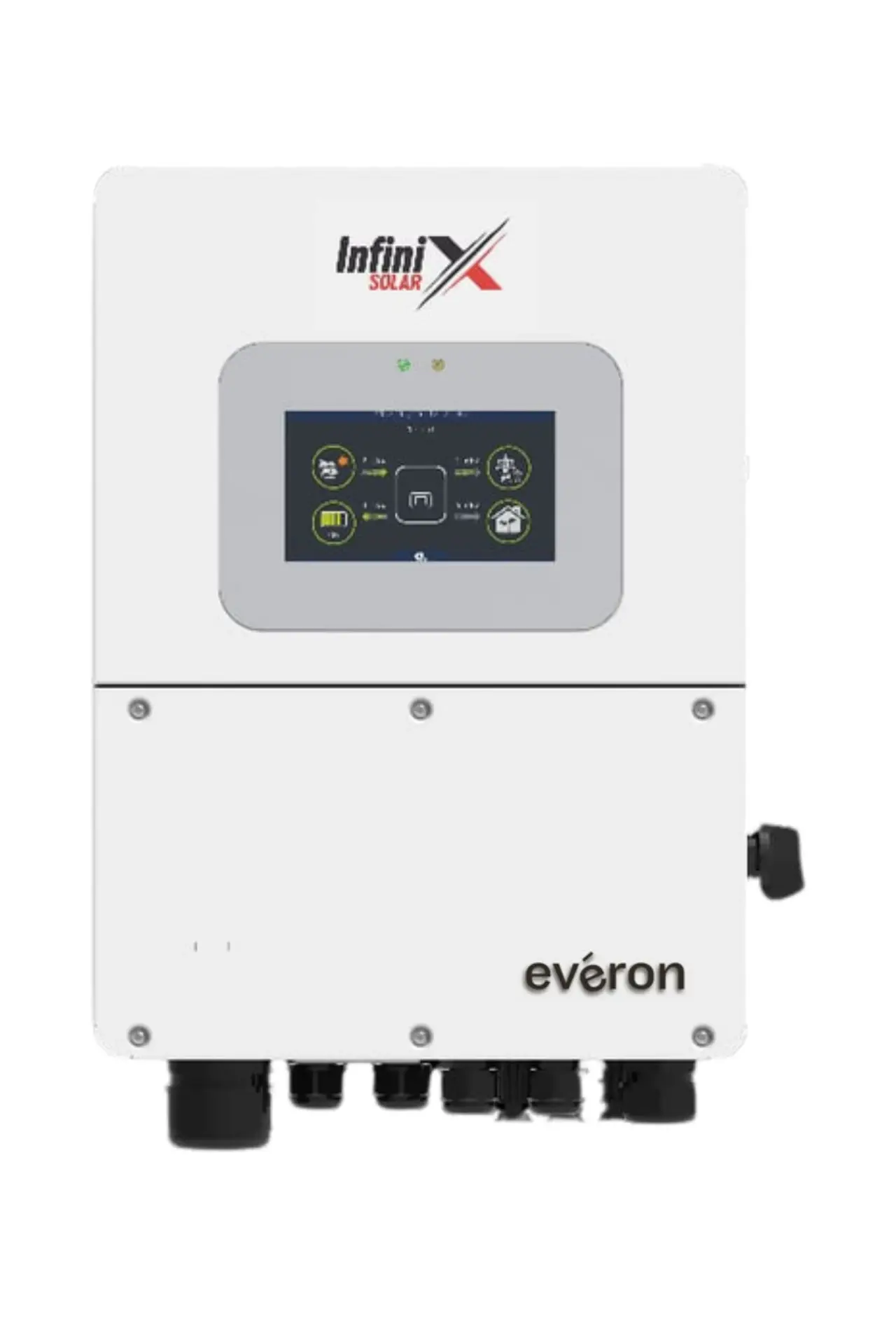
Our range runs from 1.2KW for a small home or shop up to 125KW three-phase for commercial installations, so most of these sizing outcomes map onto something directly:
- Small home or shop, one AC: the 1.2KW to 3KW class — see the Blaze Gold 3KW
- Mid-size home, two ACs: 4KW to 6KW — the Recon Series 6KW or the twin 4KW models
- Large home, three or more ACs: 8KW to 11KW — the Taycan Ultra 8/11KW
- Commercial and three-phase: the Everon range, 15KW up to 125KW
If you would rather not do the arithmetic yourself, send us a photo of a summer electricity bill and a list of your air conditioners. That is genuinely enough for us to size a system properly. Get in touch here, or browse the full range with datasheets.
Talk to an Infinix solar expert
Share your monthly units, load-shedding hours and the appliances you need to run. We will recommend the right Infinix hybrid inverter and lithium battery, with a clear itemised price.
Related reading
- Hybrid, on-grid or off-grid inverter: which one does your house need?
- Lithium vs tubular batteries: the real ten-year cost
- Net metering to net billing: what NEPRA’s 2026 rules mean for your bill
- Solar system price in Pakistan 2026: 3kW, 5kW and 10kW cost breakdown
- How to choose a hybrid solar inverter: 9 specs that actually matter
Appliance figures in this article are indicative and vary by make, age and efficiency rating. Check the rating plate on your own equipment, and have a qualified installer confirm final sizing before purchase.
Need help choosing?
Send us your electricity bill or appliance list. Our Lahore team will suggest the right Infinix inverter and battery, and share the latest price.
WhatsApp 0321-0911151Contact Us