
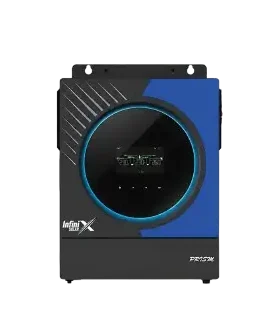
Fault codes differ from brand to brand, and even model to model, so always check your own manual first. But the underlying causes are surprisingly similar across inverters. Here are the ones we see most often, in plain language.
- Write down the exact fault code or message, and when it happens.
- Overload and over-temperature faults are usually about how the inverter is used.
- PV overvoltage often shows up on cold mornings with too many panels per string.
- Don’t open the inverter. DC from panels can be dangerous.
Overload
What it means: you’re asking for more power than the inverter can give.
Usual cause: too many heavy appliances at once. Iron plus water pump plus microwave on a 3kW inverter, for example, or a motor with a big startup surge.
What to do: spread heavy loads out. If it keeps happening with normal use, your inverter is undersized for your home.
Over-temperature
What it means: the inverter is too hot and is protecting itself.
Usual cause: installed in a closed cupboard, in direct sun, or with dust-blocked fans. Common in June.
What to do: give it space and airflow, at least a hand’s width on all sides, and clean the vents gently with a dry brush.
PV overvoltage
What it means: panel voltage is above the inverter’s limit.
Usual cause: too many panels in one string. Panel voltage rises in cold weather, so this often appears on winter mornings.
What to do: switch off PV input and call your installer. This needs re-stringing, not a reset. Read our MPPT guide to see why.
Grid fault / grid voltage out of range
What it means: the grid supply is too high, too low, or unstable.
Usual cause: weak lines in your area, especially in the evening. The inverter disconnects from grid to protect itself.
What to do: usually nothing, it reconnects automatically. If it’s constant, an electrician can check your incoming supply.
Battery low / battery under-voltage
What it means: the battery reached its cutoff point.
Usual cause: heavy night use, cloudy days, an ageing battery, or the wrong battery type selected in settings.
What to do: check the battery type setting first. If a battery that used to last all night now lasts two hours, it may be at the end of its life.
Insulation / earth fault
What it means: the inverter detects leakage between DC wiring and earth.
Usual cause: damaged cable insulation, water in a connector, or a damaged panel. Often appears after rain.
What to do: don’t ignore it. Call your installer to test the strings.
When to call for help
If a fault keeps returning, if there’s a burning smell, or if the inverter won’t start at all, switch off DC and AC isolators and call support. Infinix customers can reach our care team on WhatsApp with the fault code and a photo of the screen.
Seeing a fault code?
Send a photo of the screen and your inverter model. We’ll tell you what it likely means.